

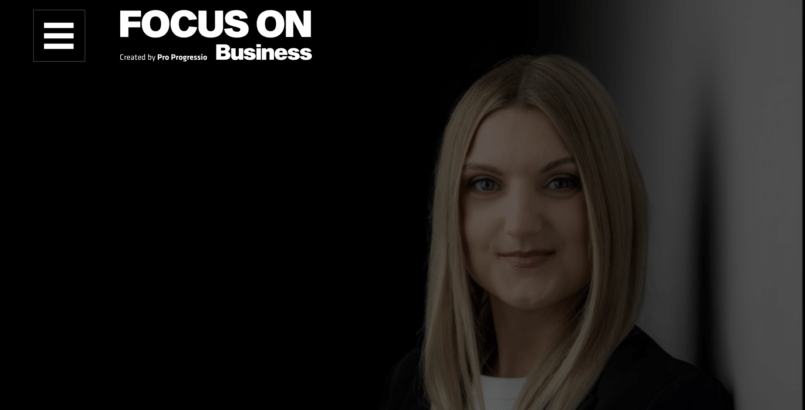
What does it take to stay competitive in the IT outsourcing market when price is no longer the only factor? In an interview with Focus on Business, a media partner of our Future of Work: Lost & Found in Flexibility report, Julita Iks shares her perspective on the changing priorities in IT outsourcing.
Read the full interview on the Focus on Business website or below. We invite you to take a look!
Talent Alpha’s report “Lost & Found in Flexibility – The Future of Work Report 2026,” points to an industry in the middle of a major structural realignment. As capability, speed, and trust overtake cost arbitrage in tech sourcing, business leaders must navigate emerging paradoxes across remote work, AI adoption, and talent engagement. In this interview, Julita Iks, CEO of Talent Alpha, discusses why traditional career ladders are fading, how to govern mixed talent ecosystems, and what truly drives competitive advantage in today’s global IT market.
FOCUS ON Business: Your report shows that cost is now the least important reason for using IT outsourcing (16%), trailing flexibility (26%), speed (20%) and access to skills (17%). That seems to overturn the narrative the industry has relied on for decades. Has outsourcing stopped being primarily a cost play and become a business of trust, speed and capability instead?
Julita Iks, CEO Talent Alpha:
Cost is still an important factor, but it is no longer the main reason companies turn to IT outsourcing. From my experience, there’s a very practical reason behind this shift. Companies often engage external partners when they realize they simply can’t deliver something with their existing internal resources – whether that’s because they lack the right expertise, don’t have enough capacity, or simply need to move faster than their internal team can.
And speed can be a real differentiator here. Hiring someone from the market can take weeks or even months, especially when you’re looking for experienced specialists who often have notice periods before they can join. Software houses and other external technology partners, on the other hand, can often provide access to ready-made teams or specialists who are available to start much sooner. That can make a significant difference when a project is already underway, and waiting is simply not an option.
Once a project is in motion, price is therefore not always the most important factor anymore. Sometimes, the cost of delaying a project – including potential penalties, missed deadlines, or the impact on the wider business – can be much higher than the short-term cost of bringing in external support. In those situations, being able to react quickly, bring the right people in, and keep the project moving can be far more valuable than simply choosing the lowest-cost option. I’ve seen situations where the real value of an external partner was not in being the cheapest, but in being the one that could step in when it mattered.
That means that outsourcing is moving from a cost-driven model towards a capability-driven one. The question is no longer simply “How much can we save?” but rather “What can we achieve faster, better or more flexibly with the right external partner?”
If competitive advantage increasingly comes from rapid access to expertise, then organizations themselves may need to be designed differently. Are companies moving away from trying to build every capability in-house and instead becoming ecosystems of employees, external specialists and strategic partners? Where is the line today between capabilities an organization must own and those it simply needs reliable access to?
Certainly, we are seeing a shift away from the idea that a company needs to build and own every capability internally. Instead, organizations are increasingly combining their core teams with external specialists and strategic partners.
The key question is no longer simply, “Should we outsource this?” but rather, “Is this a capability we need to own, or a capability we need reliable access to?”.
Companies should retain capabilities that are directly connected to their competitive advantage, strategic knowledge, customer relationships and long-term differentiation. At the same time, in areas where technology and skills are changing rapidly, having fast and reliable access to external expertise can be more valuable than trying to maintain every capability in-house.
So, the future is probably neither fully in-house nor fully outsourced. It is about building the right combination of capabilities you own and capabilities you can access through a trusted ecosystem.
Your research also highlights an interesting paradox. In Poland, 82% of organizations believe greater autonomy improves employee engagement, yet 74% say it also weakens team communication. Is this simply the price of greater flexibility, or does it reveal a more fundamental tension that organizations will have to learn to manage rather than solve?
Absolutely. That’s actually at the heart of the paradox. People with a high degree of autonomy can become extremely effective, but they may also become more focused on their own tasks, priorities, and ways of thinking. Over time, that can create silos and weaken team communication.
Remote work is a good example of this tension. When people have more autonomy over how they organize their day, they naturally want to demonstrate that this freedom translates into productivity. Informal conversations can then start to feel like “lost time” – even though those interactions often build trust, context and better collaboration. What looks like individual efficiency can therefore sometimes come at the expense of team effectiveness.
In the end, the real challenge is not autonomy itself but maintaining connection and a shared perspective while giving people the freedom to work independently.
Perhaps the most striking gap in the report is between business leaders and talent themselves. You describe it as the “Great Workforce Adaptation”: while almost all executives remain optimistic about the future, only around half of talent pool share that confidence. Where does this divergence come from? Is it merely a temporary consequence of transformation, or are leaders and employees beginning to view the future of work through fundamentally different lenses?
This is one of the most important findings in the report, and it is explored particularly well in the chapter prepared by Randstad, dedicated to what they call the “Great Workforce Adaptation.” There is a very telling sentence in the chapter: “The business optimism of leaders clashes with the stark realism of employees.” I think this captures the situation very well.
The numbers show a significant trust and perception gap. Globally, 95% of executives are optimistic about the future, while only around half of the talent pool share this confidence. In Poland, the picture is more pragmatic, with business optimism at 70%, below the global average.
I don’t think this is simply a temporary consequence of transformation. Leaders and employees are looking at the same future, but from different perspectives. Leaders tend to see the opportunities created by technology, new business models and productivity gains. Employees are more likely to ask what these changes mean for their jobs, skills, stability and career prospects.
This is why I find Randstad’s definition of the “Great Workforce Adaptation” particularly relevant. They describe it as “not merely another market shift, but a fundamental move away from traditional management toward actively building a new ground for mutual understanding.”
So yes, I think we are seeing two different perspectives, but the real challenge is to bring them together. This is where leadership plays a crucial role – creating alignment and a shared vision of what the future of work can and should look like.
Nearly 90% of outsourced IT projects are delivered by teams of ten people or fewer. That may signal more than a shift in project size. Is the small, highly specialized project team becoming the new fundamental building block of modern organizations? And if so, what does that mean for concepts such as organizational culture ?
I think small, specialized teams can absolutely become the building blocks of modern organizations, especially as AI and automation allow smaller teams to deliver more value at a lower cost. That can become a real competitive advantage.
At the same time, I would be careful about drawing a direct link between smaller teams and a fragmented organizational culture. Most of our respondents are software houses, where small project teams are already a natural way of working, and people often move between teams depending on the project. These teams are not necessarily separate worlds; they are fluid and interconnected.
A team can be highly focused on its own project while still sharing the same values, principles, and sense of purpose at the organizational level.
Maybe the future is not about making everyone work together all the time, but about creating a strong enough common foundation that allows small teams to operate independently while still feeling connected to the wider organization.
One broader theme running through the report is that countries are increasingly competing not only through labour costs, but through the quality of their business environment. As global talent markets become more fluid, are institutional stability, regulatory clarity and access to skills becoming stronger competitive advantages than labour arbitrage ever was?
Absolutely. This becomes even more important in highly regulated industries such as banking, insurance, or healthcare. In these sectors, companies are not just looking at labour costs – they need to know that the regulatory environment is clear and predictable enough to operate with confidence.
Labour costs are relatively easy to compare, but uncertainty is much harder to price. If you don’t know how a regulation will be interpreted, how long a process might take, or whether the rules will change, the initial cost advantage can quickly disappear.
I think countries are increasingly competing on something broader than cost: how easy and predictable it is to do business there. Access to skilled talent obviously matters, but so does the confidence that comes with a stable and transparent environment. In some industries, that confidence may be just as important as the cost of labour.
The report also points to a significant gap in AI adoption. Globally, 63% of organizations invested in AI over the past year, compared with just 38% in Poland. At the same time, employees increasingly expect their employers to invest more aggressively in AI capabilities. Which carries the greater strategic risk today: moving too quickly, or falling behind?
I would say that today, the greater strategic risk is falling behind, but our previous report, “Lost & Found in Technology,” showed that simply moving faster is not enough.
One of its key findings was the gap between declared readiness for technological change and actual readiness to implement it. Organizations often said they were ready for AI and transformation, but when it came to skills, processes, leadership and execution, that readiness was much less evident. There is often a long road between saying “we are ready” and actually implementing change.
The real question is whether organizations have the people, skills and processes to turn AI investment into business value.
The challenge is not simply moving faster or avoiding falling behind. It is moving from intention to implementation and doing it with a realistic understanding of organizational readiness.
Your findings suggest that the traditional linear career path is becoming increasingly disconnected from the realities of today’s labour market, where success depends on continuously acquiring and redeploying skills across changing projects. If the conventional career ladder is fading, what is replacing it in practice?
I think what is replacing the traditional career ladder is more of a career built around skills, projects and experiences. Instead of moving in a straight line from one role to the next, people can grow by taking on different challenges, working with different teams or clients, and continuously adding new skills.
We can see this quite clearly in IT. Some relatively young professionals have reached a very comfortable financial position quite early in their careers. Once another promotion no longer makes a significant difference to their lifestyle, the motivation can shift. They may care more about working on interesting projects, using the latest technologies, learning something new or simply having more freedom in what they do.
Ultimately career progression becomes less about “What is my next title?” and more about “What can I do next that I couldn’t do before?” The career path may be less linear, but it can also become more about learning, relevance, and the quality of the work itself.
One of the report’s most compelling ideas is the concept of the “augmented workforce” – organizations where employees, freelancers, outsourcing partners and AI agents operate as a single ecosystem. It is an attractive strategic vision, but it also raises practical questions about leadership, accountability and decision-making. Are businesses already learning how to govern these mixed workforces, or are most of them still improvising?
In my opinion, most organizations are still figuring it out. From my conversations with clients, I also see that this tends to work better when the people making these decisions have experience on both sides – they have worked within an internal organization but also experienced the delivery side as a supplier or outsourcing partner.
That perspective makes a real difference. These people tend to have a better understanding of what each part of the ecosystem can actually bring, and they are often more comfortable treating external partners, freelancers or AI as an extension of the team rather than something that needs to be managed separately.
The challenge is still accountability. When employees, external partners and AI all contribute to the same outcome, you need to be very clear about who owns the decision and the result. But I don’t think we need to have the perfect governance model before we start. The organizations that learn fastest will probably be those willing to experiment, learn from what works, and gradually build the right structures around it.
Finally, there is the question of long-term competitiveness. Central and Eastern Europe built its position in global outsourcing on cost efficiency and engineering talent. As new delivery hubs emerge – particularly across Africa – what will define the next stage of competitiveness for CEE? In other words, how does the region move from competing on price to competing on value that is genuinely difficult to replicate?
In practice, the picture is a bit different. We hear a lot about new delivery hubs, including Africa, but in my conversations with clients, I still see a strong preference for providers that are closer to them geographically, culturally and from a regulatory perspective. Many companies are willing to pay more for that proximity and the ease of working together.
So, I don’t think CEE should try to compete simply by being cheaper. The region already has some strong advantages – good engineering talent, cultural proximity, and a good understanding of European business. I also think CEE has an opportunity to move beyond simply providing people and become more of a strategic partner for clients.
For me, the next step is moving from “we can give you good people at a good price” to “we understand your business and can help you solve your problems.” That kind of value is much harder to copy, than a lower cost.
The Future of Work Report 2026 “Lost & Found in Flexibility” is available for download for free here: https://report.talent-alpha.com/the-future-of-work-report-2026-lost-and-found-in-flexibility
FOCUS ON Business editorial team.
Read also
Talent Alpha now has 1,000 partners in 55 countries
The Future of Work Report 2024 is here
A comprehensive guide for leaders in today's and tomorrow’s AI-ed world.
The Tech Talent Business Survey Report 2023 is now released
43% of IT service companies are experiencing a shortage of new business opportunities. Find out what else has shifted in this year’s report.